

Newborn circumcision healing requires seven to ten full days. During the first two days, the raw glans looks dark red and glossy. You will see mild swelling at the tip. You may also see light spots of blood in the diaper. By Day 3, the body produces a moist, yellow-white fibrin film over the incision line. This yellow film is normal granulation tissue. It is not an infection. By Day 10, the incision consolidates into smooth, pale pink skin. Parents protect this healing skin with thick ointment barriers. Use gentle warm-water rinses. Fasten diapers loosely at every change.
Families across New York City frequently bring their newborn sons to East Coast OBGYN for in-office newborn circumcision services in Brooklyn and Manhattan. Dr. Mark Vaynkhadler, MD performs gentle procedures in fully sterile surgical suites. The procedure takes under ten minutes in our office. Careful home aftercare shapes the speed and comfort of your baby’s recovery. Post circumcision care newborn routines shield raw skin, speeds tissue closure, and keeps your baby calm throughout the healing process.

Baby Circumcision Healing Time: What to Expect in Newborns
The average baby circumcision healing time takes seven to ten days for complete skin recovery. The surgical incision seals within 48 hours, meatal swelling peaks on Day 3, and a protective yellow fibrin crust covers the glans from Day 3 to Day 7. Healthy skin covers the area by Day 10.
Baby skin heals fast. Strong blood flow and natural growth factors speed recovery. Parents who want to know how to heal circumcision wound faster should follow three rules: change diapers promptly, apply generous petroleum jelly at every check, and never scrub healing crusts. Three main factors shape overall healing speed: the clamp tool, diaper friction, and steady moisture barriers.
Surgical Technique and Clamp Selection
The surgical instrument chosen for the procedure shapes the visible healing timeline.
Precision clamps like the Gomco or Mogen crush and seal foreskin blood vessels. The doctor then removes the tissue. The doctor places a clean gauze pad with petroleum jelly over the tip right after surgery. The incision begins sealing within hours. Most Gomco and Mogen clamp wounds heal fully within seven to nine days.
The Plastibell device uses a plastic ring. The ring ties around the foreskin collar to stop blood flow. The foreskin edge withers. It falls away with the plastic ring between Day 5 and Day 10. Parents do not apply gauze dressings over a Plastibell ring. Full skin closure takes eight to twelve days.
Diaper Friction and Moisture Control
A newborn urinates twenty or more times each day. Ammonia in urine and bacteria in stool can irritate raw skin edges. Raw skin sticks to dry diaper fabric. Pulling a stuck diaper tears fresh skin cells. It causes bleeding and slows down healing. Apply a thick layer of petroleum jelly at every diaper check. This simple habit cuts healing time by two to three days.
Day-by-Day Circumcision Healing Stages: What Normal Recovery Looks Like
Normal circumcision healing progresses through three distinct clinical stages across ten days. The site shifts from acute surgical erythema to active yellow granulation, and finally to smooth pink epithelial tissue. Tracking daily visual signs gives parents peace of mind during home recovery.
Days 1 to 2: Initial Clotting, Meatal Edema, and Diaper Spotting
The penis appears glossy, bright red, and swollen immediately after the procedure. The meatus (the urinary opening at the tip) shows mild puffiness. A small dab of dried blood or a few drops of pink tinged fluid on the diaper gauze is normal post-surgical oozing.
Your baby must wet his diaper within six to eight hours after surgery. A wet diaper confirms that mild swelling does not block his urine flow. The baby may cry during his first few wet diapers. Acid in fresh urine can sting raw skin edges. He will calm down quickly once you feed or rock him. Keep the first clinic gauze pad in place as directed. Then apply fresh petroleum jelly pads at each diaper change.
Days 3 to 6: The Yellow Fibrin Film and Active Granulation
Day three brings the peak of visible changes and parent anxiety. A thin, moist, yellow-white film coats the head of the penis. It forms a ring around the cut edge. Many parents mistake this film for pus or infection.
This yellow film is made of fibrin, lymph fluid, and white blood cells. It forms a wet scab. This scab shields tender nerve endings while new skin cells grow across the area. Do not wash, wipe, rub, or scrape this yellow crust away. Scrubbing tears delicate new blood vessels. It causes fresh bleeding and lets bacteria into deeper tissue. The yellow film stays visible for three to four days. It dissolves on its own.
Days 7 to 10: 1 Week After Circumcision and Final Skin Retraction
At 1 week after circumcision, the yellow fibrin film recedes naturally. Warm-water rinses wash it away without scrubbing. The skin underneath looks smooth, dry, and healthy pink. The cut edge seals into a clean line. Swelling subsides completely. The penis shaft now rests in its natural position.
With a Plastibell device, the plastic ring falls off between Day 6 and Day 9. Never pull or twist a loose ring. Let the ring fall off on its own. By Day 10, raw skin edges close completely. At 2 weeks after circumcision, the surgical seam seals fully, and you can transition comfortably from sterile dressings to normal baby baths.
Circumcision Healing Milestone Summary
| Recovery Phase | Typical Visual Appearance | Normal Physical Sensations | Essential Care Directive |
|---|---|---|---|
| Days 1 to 2 | Bright red glans, mild meatal swelling, small blood spots | Mild tenderness during urination | Verify first urine within 8 hours; apply petroleum jelly at every check |
| Days 3 to 6 | Yellowish-white fibrin film, reduced swelling, glossy edges | Decreasing sensitivity; comfortable diapering | Do not scrub yellow crust; apply generous ointment dollops |
| Days 7 to 10 (1 Week) | Smooth pale pink skin, resolved crust and ring detachment | Normal touch tolerance; zero distress | Transition to gentle baths; check for natural skin movement |
| Days 11 to 14 (2 Weeks) | Fully healed epithelial seam, normal skin color, zero scabs | Complete comfort during diaper changes | Resume standard baby bathing; apply maintenance ointment if needed |
Yellow Crust or Infection? Clinical Triage for Anxious Parents
A yellow film on a healing cut is normal granulation tissue. It is not an infection. Granulation tissue appears as a flat, odorless, moist yellow-white coating between Days 3 and 6. In contrast, an infection produces thick foul-smelling yellow-green pus. It creates red skin margins, severe swelling, and rectal fever.
Knowing the difference gives parents peace of mind. Recognizing a post circumcision infection early ensures fast medical care. True post circumcision infections occur in less than one percent of clinic circumcisions.
Clinical Triage Comparison: Granulation Tissue vs. Bacterial Infection
| Clinical Feature | Normal Fibrin Granulation Crust | Bacterial Infection or Cellulitis |
|---|---|---|
| Discharge Consistency | Thin, glossy, flat, moist film or wet scab | Thick, opaque, creamy, pooled fluid |
| Discharge Color | Creamy yellow, soft white, or pale amber | Cloudy dark yellow, neon yellow, or green |
| Odor | Completely odorless or mild clean scent | Sour, putrid, or distinctly foul odor |
| Surrounding Redness | Faint pink halo confined to cut edge | Angry red border spreading down the shaft |
| Swelling Progression | Peaks on Day 3 and steadily declines | Worsens after Day 4; skin feels tight and hot |
| Infant Demeanor | Feeds well, sleeps normally, soothes easily | High-pitched crying, refuses feeds, lethargic |
| Body Temperature | Normal rectal temperature under 100.4°F | Fever of 100.4°F (38°C) or higher |
If your baby shows normal yellow film with no odor, fever, or spreading redness, keep applying petroleum jelly. If you see thick green pus, foul odor, or spreading red skin, call East Coast OBGYN right away at (718) 769-6868 for an urgent clinic visit.
Daily Diaper Changes: Step-by-Step Circumcision Post Op Care Routine
Perform circumcision post op care at every diaper change. Continue this for seven to ten straight days. Clean the area with warm water. Pat dry with clean gauze. Apply a thick nickel-sized dollop of white petroleum jelly. Fasten the diaper loosely to avoid pressure.
Consistency is key. A steady diaper routine blocks bacteria and keeps healing skin moist day and night.
Step 1: Wash Your Hands Thoroughly
Wash your hands with soap and warm water for twenty seconds before every diaper change. Newborn skin lacks mature defenses. Clean hands stop household germs from reaching the raw wound.
Step 2: Remove the Soiled Diaper Gently
Open diaper tabs slowly. Lift the front gently to check if the fabric touches the penis. If you feel pulling, stop right away. Use the stuck-gauze release steps shown below.
Step 3: Clean the Surrounding Skin and Stool
Circumcision cleaning the wound requires gentle warm water. Never scrub raw skin. Never use alcohol wipes or scented wet wipes on the healing penis. Avoid soapy washcloths. Commercial wipes contain harsh chemicals. These ingredients sting raw skin and slow down healing.
For urine, squeeze warm water from a cotton ball or squeeze bottle over the tip. Let water run gently over the skin.
When cleaning newborn bowel movements:
- Wipe feces away from the groin, scrotum, and thighs using water-moistened cotton pads, Always wipe from front to back.
- If stool touches the penis, rinse the area with warm water from a squeeze bottle.
- Allow the water flow to rinse the stool away.
- If stool sticks to ointment, dab the spot with a wet cotton ball. Never rub or scrub raw skin.
- Pat nearby skin dry with a soft towel or sterile gauze pad.
Step 4: Apply a Generous Petroleum Jelly Barrier
Where to apply Vaseline after circumcision: squeeze a nickel-sized dollop directly onto the head of the penis. You can also place it in the center of a fresh gauze pad. Coat the entire head, the incision seam, and the underside of the shaft.
Do not use a thin layer. Apply a thick mound of ointment. The ointment acts as a soft buffer. The diaper presses against slick jelly without touching raw skin. Place an extra dollop of jelly on the diaper lining where the penis rests.
Step 5: Fasten the Diaper Loosely
Place the diaper comfortably around his hips. Fasten tabs loosely to leave breathing space around the groin. Tight diapers press the incision against clothing. They trap heat and increase swelling. Fold the top waistband down so rough edges do not rub the healing tip.
Aquaphor vs. Vaseline: Can You Use Aquaphor on Circumcision?
Can you use Aquaphor on circumcision? Yes, parents can use Aquaphor on circumcision wounds. But pure white petroleum jelly remains the top choice. Both products seal in moisture. But doctors recommend pure white petroleum jelly for newborn wounds.
Vaseline contains one ingredient: pure white petroleum jelly. It has no scents, no preservatives, and no additives. It creates a safe shield with almost zero allergy risk.
Aquaphor contains 41 percent petrolatum. It mixes mineral oil, lanolin alcohol, and glycerin. Lanolin alcohol can spark allergies in sensitive babies. This reaction brings red bumps that look like an infection. Pure white petroleum jelly gives the safest care for newborn surgical skin.
Can You Use Circumcision Antibiotic Ointment on Newborns?
Parents often ask if they should apply a circumcision antibiotic ointment like Neosporin or Bacitracin. Pediatric guidelines advise against over-the-counter antibiotic ointments on newborn wounds. These ointments often trigger skin allergies in sensitive babies. This reaction causes red bumps and redness that look like an infection.
Unless Dr. Mark Vaynkhadler, MD prescribes a topical antibiotic, use pure white petroleum jelly exclusively. Petroleum jelly gives ideal moisture without harsh chemicals.
The Essential Newborn Circumcision Care Kit
Organize these essential supplies on your changing station before bringing your baby home.
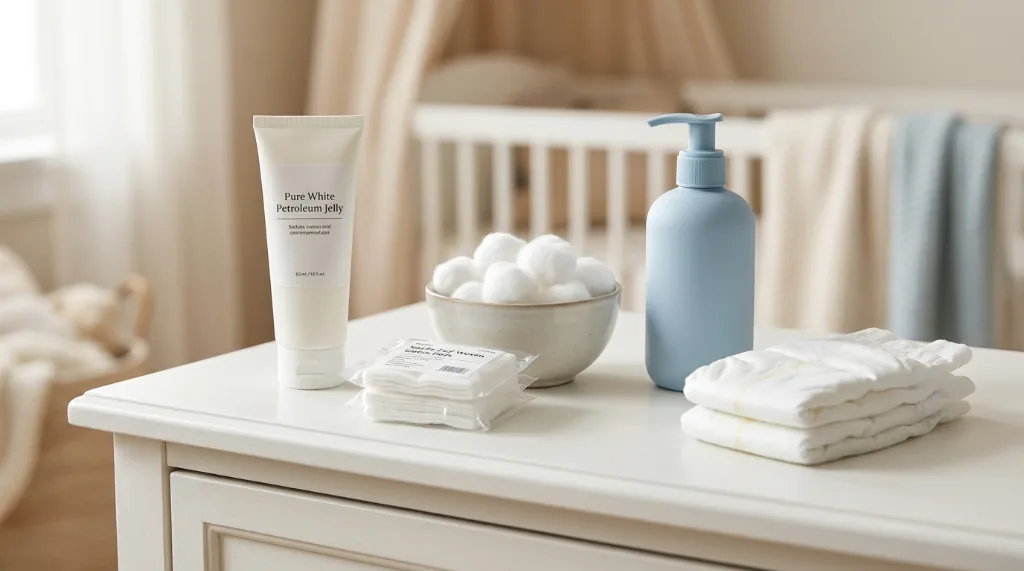
Keep a large squeeze tube of pure white petroleum jelly on hand. Squeeze tubes prevent bacterial contamination from repeated hand dipping. Stock several boxes of individually wrapped sterile two-by-two cotton gauze pads. Pure cotton balls provide soft, lint-free application during warm water cleansing. A clean peri-bottle or bulb syringe allows steady, gentle water irrigation without touching raw skin. Keep plenty of fragrance-free, high-absorbency diapers ready in the correct newborn size.
Acute Recovery Dilemmas: Stuck Gauze and Skin Adhesion Prevention
Two issues cause stress for parents: gauze sticking to raw tissue, and shaft skin sticking to the head. Simple clinical techniques resolve both issues safely without surgery.
How to Release Gauze Stuck to the Healing Glans Safely
If gauze dries onto the wound, never pull or yank the fabric away. Pulling stuck gauze tears away new skin cells. It causes fresh bleeding and invites germs.
Follow this gentle three-step soaking protocol:
- Do Not Pull: Keep the baby calm. Leave the stuck gauze exactly as it rests.
- Soak with Warm Water: Wet a clean cloth or cotton pad with warm water. Squeeze warm water over the stuck gauze for two to three minutes until the fabric is soaking wet.
- Add Petroleum Jelly and Wait: Cover the wet gauze with a thick layer of petroleum jelly. Close the diaper loosely and wait ten to fifteen minutes. Warm water and oil soften the dry scab. Open the diaper and lift the gauze edge gently. The wet pad will slide off on its own. If it catches, add more warm water and wait five more minutes.
Preventing Foreskin Adhesions and Penile Skin Bridges After Day 7
Between two and six weeks, shaft skin can slide forward. It may stick to the raw groove behind the head of the penis. This condition is a foreskin adhesion. If ignored, blood vessels grow into the connection. This bond forms a skin bridge. A skin bridge requires surgical repair.
Starting on Day 7, add gentle skin rollback to your diaper routine once your doctor approves:
- Clean your hands and apply a small dab of petroleum jelly to your index finger and thumb.
- Place your fingers on the shaft of the penis just below the head.
- Push the shaft skin gently downward toward his belly until you see the full groove behind the head of the penis.
- You may see white material collect in this groove. Clean it away gently with a wet cotton ball.
- Coat the groove with petroleum jelly. Then release the skin.
Do this gentle push once or twice daily. It stops skin from sticking and keeps the area clean for a great long-term result.
Urgent Pediatric Warning Signs: When to Seek Medical Attention
Complications after clinic circumcision are rare. Still, parents should know clear warning signs that call for a doctor visit. Contact your healthcare provider or visit an urgent care center if your infant displays any of the following symptoms:
- Active Bleeding: Light blood spots smaller than a US quarter are normal on Days 1 and 2. If you see steady dripping, or blood that soaks a diaper, press a clean gauze pad gently on the spot for five minutes. If bleeding continues after five minutes of pressure, seek immediate emergency medical care.
- Urinary Retention: If your baby does not wet his diaper within six to eight hours, call your doctor right away. Swelling at the tip may slow urine flow.
- Spreading Infection: A red ring spreading down the shaft or belly, dark skin colors, or cloudy foul discharge calls for fast medical care.
- High Fever: A rectal temperature measuring 100.4°F (38°C) or higher in an infant under three months old is a medical emergency.
- Plastibell Ring Complications: If a Plastibell ring slips down the shaft, stays past Day 10, or causes dark swelling, call your doctor to remove it.
For parents who had their procedure performed at East Coast OBGYN, our clinical team provides comprehensive follow-up support. If you observe unusual swelling, persistent crying, or require post-circumcision pain treatment in Brooklyn or Manhattan, our team evaluates your baby promptly. Review our newborn circumcision aftercare guidelines or contact East Coast OBGYN for post-procedure evaluation directly at (718) 769-6868.
Common Questions About Newborn Circumcision Healing and Aftercare
When can my baby have a bath after circumcision?
You can give your baby a full tub bath once the circumcision heals completely, usually ten to fourteen days after surgery. Give gentle warm sponge baths during the first seven to ten days. Tub water softens healing tissue too early and raises infection risk. Wait until the yellow crust falls away, the skin looks smooth, and the umbilical cord stump detaches before starting tub baths.
What happens if the yellow scab peels off early?
If the yellow fibrin scab peels off prematurely due to diaper friction, you may notice a small dab of fresh pink spotting on the diaper. Do not panic. Rinse the area with warm water. Pat dry gently. Put a thick layer of petroleum jelly over the spot. The body will quickly regenerate a fresh layer of protective fibrin. Check the diaper tabs to ensure you fasten clothing loosely.
Why does the tip look bruised or dark red after surgery?
A dark red or purple color on the head of the penis is normal bruising. During the procedure, surgical clamps apply pressure to the foreskin to stop bleeding. This pressure naturally causes mild local bruising in surrounding capillaries. As long as the skin remains pink or purple, the baby urinates normally, and the tissue feels soft and does not feel hard to the touch, the discoloration will fade to normal skin tones within seven days.
How many days should I continue applying petroleum jelly?
Apply pure white petroleum jelly at every diaper change for a minimum of seven to ten full days. Once the yellow crust dissolves and the skin appears pale pink and completely dry, you can stop using gauze squares. Doctors suggest putting a dab of petroleum jelly on the tip for two more weeks. This stops dry friction against diapers.
Is it safe to use diaper rash creams on the incision line?
Never apply diaper rash creams containing zinc oxide, white petrolatum pastes, or fragrances directly onto an open circumcision incision. Zinc pastes are thick and chalky. They are hard to wash off without rubbing. Rubbing chalky cream off raw tissue causes severe pain and bleeding. It tears open delicate skin. Use 100% pure white petroleum jelly exclusively until the surgical wound closes completely.
Families preparing for an upcoming arrival can explore comparing a board-certified physician to a traditional mohel or read our guide on preparing your infant for clinical circumcision to plan a safe, stress-free recovery. For families living in Brooklyn or Manhattan, our experienced surgical team at East Coast OBGYN provides gentle, compassionate care across all our infant circumcision clinics across NYC.
Planning your baby’s circumcision? Dr. Mark Vaynkhadler performs in-office newborn circumcision in Brooklyn and Manhattan. See what to expect and how to book, or call (718) 769-6868.