

Getting a call from your doctor’s office saying your Pap smear results are “abnormal” is a moment that strikes fear into the hearts of many women. The immediate, terrifying thought is often, “Do I have cancer?”
Take a deep breath. The short answer is: almost certainly not.
An abnormal Pap smear is incredibly common, and in the vast majority of cases, it does not mean you have cervical cancer. It simply means that some of the cells collected from your cervix look different than normal, healthy cells under a microscope. The Pap smear is a screening tool, not a diagnostic tool. Its entire purpose is to catch these cellular changes early—years or even decades before they could potentially develop into cancer—so they can be monitored or treated.
This article will demystify abnormal Pap smear results, explain the medical jargon on your lab report, discuss the crucial role of HPV, and outline exactly what your next steps will be. For a broader understanding of routine screenings and sexual health, we recommend reading our comprehensive guide: STD Testing and Sexual Health: The Definitive Guide for Every Woman.
The Role of HPV (Human Papillomavirus)
To understand abnormal Pap smears, you must understand HPV. The Human Papillomavirus is the most common sexually transmitted infection in the world. It is so common that nearly all sexually active men and women will contract at least one strain of it at some point in their lives.
There are over 100 strains of HPV. Some cause genital warts (low-risk strains), while others (high-risk strains, particularly HPV 16 and 18) can cause changes in the cells of the cervix.
In most cases, your immune system will fight off the HPV infection on its own within a year or two, and the cervical cells will return to normal. However, if a high-risk strain of HPV persists for many years, it can cause the cells to become increasingly abnormal, eventually leading to cervical cancer if left untreated. This is why many Pap smears are now “co-tested” with an HPV test.
Decoding Your Results: What the Jargon Means
When your doctor says your results are abnormal, they are referring to specific classifications of cellular changes. Here is a breakdown of the most common terms you might hear:
1. ASC-US (Atypical Squamous Cells of Undetermined Significance)
This is the most common abnormal result. It means the cells look slightly unusual, but the cause is unclear. It could be related to an HPV infection, but it could also be caused by inflammation, a yeast infection, or even hormonal changes (like menopause).
- What it means: Very low risk. It is a “borderline” result.
2. LSIL (Low-Grade Squamous Intraepithelial Lesion)
“Low-grade” means there are early, mild changes in the size and shape of the cells. “Squamous” refers to the flat cells that cover the outer surface of the cervix. LSIL is almost always caused by an HPV infection.
- What it means: Low risk. These mild changes often resolve on their own as the immune system clears the HPV virus, especially in younger women.
3. HSIL (High-Grade Squamous Intraepithelial Lesion)
“High-grade” means the cells look very different from normal cells. These are more pronounced, moderate-to-severe changes.
- What it means: Higher risk. While it is still not cancer, HSIL indicates that the cells are more likely to progress to precancer or cancer if they are not treated.
4. ASC-H (Atypical Squamous Cells, Cannot Exclude HSIL)
This means the cells look abnormal, and while they don’t clearly meet the criteria for HSIL, the pathologist cannot rule out the possibility that high-grade changes are present.
- What it means: Moderate-to-high risk. It requires further investigation.
5. AGC (Atypical Glandular Cells)
Glandular cells are the mucus-producing cells found in the inner canal of the cervix and the uterus. Atypical glandular cells mean these cells look abnormal.
- What it means: Higher risk. This result is less common and requires careful evaluation to rule out precancer or cancer in the upper part of the cervix or the uterus.
Your Next Steps: Follow-Up and Treatment
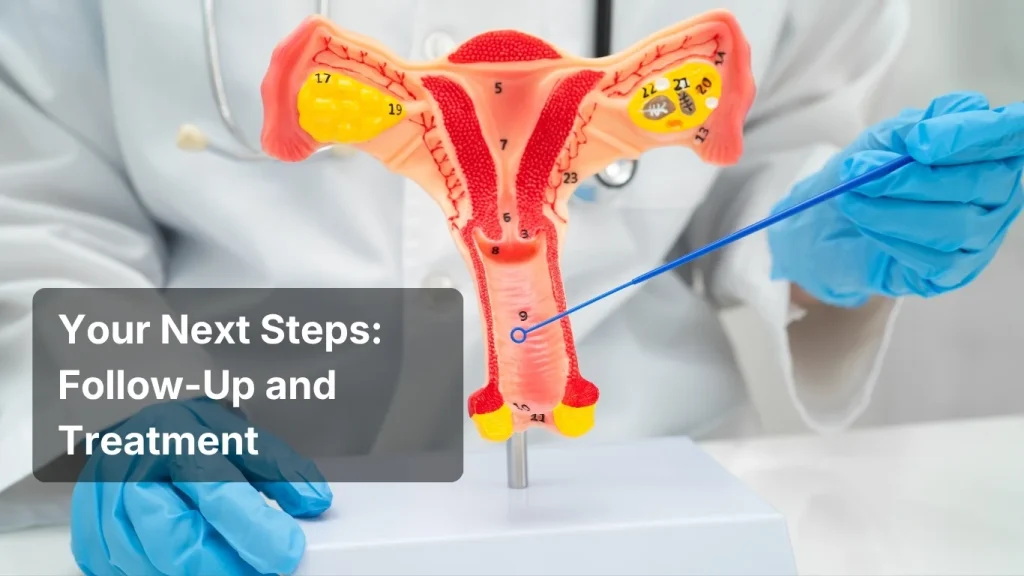
If your Pap smear is abnormal, your doctor will recommend a follow-up plan based on your specific result, your age, and your HPV status. The goal is to monitor the cells or remove them before they can become dangerous.
1. “Watch and Wait” (Repeat Testing)
For mild abnormalities like ASC-US or LSIL, especially in women under 25 or those who test negative for high-risk HPV, the recommendation is often simply to repeat the Pap smear and HPV test in one year. Because the immune system frequently clears the virus and the cells return to normal, immediate intervention is often unnecessary and can lead to overtreatment.
2. Colposcopy
If your results show HSIL, ASC-H, AGC, or if you have persistent mild abnormalities and test positive for high-risk HPV, your doctor will likely recommend a colposcopy.
A colposcopy is an in-office procedure that feels very similar to a Pap smear. Your doctor will use a special magnifying instrument (a colposcope) to closely examine your cervix under bright light. They will apply a mild vinegar solution to the cervix, which turns any abnormal areas white, making them easier to see.
3. Biopsy
During the colposcopy, if your doctor sees any suspicious areas, they will take a tiny tissue sample (a biopsy). This can cause a brief pinch and some mild cramping. The tissue is sent to a lab for a definitive diagnosis. The biopsy results will determine if any treatment is needed.
4. Treatment to Remove Abnormal Cells
If the biopsy confirms the presence of moderate to severe precancerous cells (often referred to as Cervical Intraepithelial Neoplasia, or CIN 2 and CIN 3), your doctor will recommend a procedure to remove them. Common treatments include:
- LEEP (Loop Electrosurgical Excision Procedure): A thin wire loop carrying an electrical current is used to remove the abnormal tissue.
- Cryotherapy: The abnormal cells are frozen and destroyed.
- Cone Biopsy (Conization): A cone-shaped piece of tissue containing the abnormal cells is removed, usually in an operating room.
Prevention is the Best Medicine
While abnormal Pap smears are common, there are highly effective ways to protect yourself:
- Get Vaccinated: The HPV vaccine (Gardasil 9) protects against the strains of HPV that cause the vast majority of cervical cancers and abnormal Pap smears. It is recommended for everyone up to age 26, and often up to age 45.
- Keep Your Screening Appointments: Regular Pap smears and HPV tests are your best defense. They catch changes when they are easily treatable.
- Don’t Smoke: Smoking weakens the immune system, making it harder for your body to clear an HPV infection and increasing the risk that abnormal cells will progress to cancer.
- Use Condoms: While condoms do not offer 100% protection against HPV (because the virus is spread through skin-to-skin contact), they do reduce the risk of transmission.
An abnormal Pap smear is a call to action, not a cause for panic. It means the screening system is working exactly as it should. At East Coast OBGYN, we understand the anxiety these results can cause. Our team is here to explain your results clearly, guide you through any necessary follow-up procedures with compassion, and provide the expert care you need to protect your health. If you are due for your routine screening or have questions about your results, schedule a gynecological care appointment at our Brooklyn or Flushing clinic today.